Picture a recruiter on a Monday morning. Two hundred new applications sit in the inbox, three interviews still need calendar slots, and a hiring manager has just pinged to ask why the shortlist isn’t ready. Nothing about this scene is new. What is new is that a growing number of teams now walk into that Monday with software that has already read the applications, ranked them, and offered interview slots to the best matches.
That shift is behind a question I hear from HR leaders again and again: how do AI hiring tools differ from traditional recruiting software? It sounds like a simple feature comparison, but the real answer is about a change in what the software is for. Older systems were built to remember things. Newer ones are built to help you decide things.
The pace of adoption suggests this isn’t a passing trend. One widely cited Gallup survey found that 93% of Fortune 500 CHROs have already started using AI tools in HR and recruiting. In this guide, we’ll walk through how recruiting got here, where the old approach still earns its keep, where AI genuinely changes the work, and how to think about the balance between the two.

Table of Content
Overview of Traditional Recruitment Methods
For a long time, hiring followed a rhythm everyone knew by heart: post the job, wait for applications, read resumes, call the promising ones, schedule interviews, collect feedback, make an offer. Applicant tracking systems came along to give that rhythm a home, a tidy digital filing cabinet where candidate records, notes, and stages lived in one place.
That model got a lot right. It kept hiring documented and compliant, and it gave recruiters and hiring managers a shared place to leave feedback. Traditional recruitment methods also keep a human being at the center of every judgment call, which still matters enormously for senior roles and for jobs where trust is built early.
But a filing cabinet only works as well as the person doing the filing and reading. As application volumes climbed, cracks started to show.
Challenges in Traditional Recruitment
The biggest challenge is simply time. When every resume is read one at a time and every interview is arranged through a chain of emails, the process stretches. One industry source puts the average time-to-hire at around 44 days. That’s six weeks of projects waiting on a seat to be filled, and six weeks in which a strong candidate can accept someone else’s offer.
There’s also the matter of consistency. A recruiter reviewing resumes at 9 a.m. with a fresh coffee isn’t evaluating them the same way as at 5 p.m. with forty tabs open. Add rigid workflows that don’t bend when a role changes, and reporting that tells you what happened last quarter but not what to do next, and you can see why many teams feel they’re working for their software rather than the other way around.
Role of Resume Parsing Software
Resume parsing software was one of the first real attempts to take weight off recruiters. It pulls names, job titles, skills, and dates out of uploaded documents and turns them into searchable fields, so you don’t have to retype anything into a database.
It’s genuinely useful, and nearly every modern ATS includes it. But parsing is extraction, not understanding. A parser can tell you a candidate listed “project management” as a skill. It can’t tell you whether that meant running a team of fifteen across three time zones or coordinating a single office move. It reads what’s written and files it away, and that’s where its job ends.
Limitations of Candidate Screening Technology
The screening layer built on top of parsing, the older generation of candidate screening technology, mostly works through keyword matching. Search for “Salesforce administrator,” and you’ll see profiles that contain those words. Strong candidates who phrased their experience differently, or who built the same skills under a different job title, can slip straight past.
Keyword filters also create a quiet pressure on applicants. People learn to stuff resumes with the right terms, which means the filter ends up rewarding good formatting as much as good experience. For recruiters, the result is a shortlist that feels precise but often isn’t.
Evolution of AI Hiring Tools
What changed wasn’t one invention but a few arriving together: machine learning that can spot patterns across thousands of past hires, natural language processing that reads meaning rather than just matching strings, and conversational interfaces that let software actually talk to candidates. Put together, they turned recruiting software from a place where information sits into something that works on that information.

What Is AI Hiring Software?
AI hiring software uses machine learning and language understanding to help with sourcing, screening, and evaluating candidates. Instead of waiting for applications to land in a database, it can reach out to passive candidates, ask follow-up questions, answer applicant queries at any hour, and summarize what it learned for the hiring team.
The cleanest way I can put the difference is this: a traditional system is reactive record-keeping, and an AI tool is proactive decision support. One waits for you to ask it something. The other brings you what you probably need to see.
Key Features of AI Hiring Tools
When you strip away the marketing language, a handful of capabilities show up again and again:
- Context-aware screening: It evaluates how deep a candidate’s experience is, not only whether the right words appear.
- Proactive sourcing: It searches talent pools and re-engages past applicants when a similar role opens.
- Conversational engagement: It sends quick updates by text or chat, so candidates aren’t left guessing after they apply.
- Workflow automation: It handles reminders, stage changes, and status updates that used to eat recruiter hours.
- Structured summaries: It gives hiring managers scorecards rather than a pile of PDFs.
None of these require recruiters to step aside. They just move the repetitive weight somewhere else.
Job Matching Algorithms: Revolutionizing Candidate Selection
Job matching algorithms are where the contrast with older systems is sharpest. Instead of asking whether a resume contains the words in a job description, a matching model compares the whole picture: skills, career progression, certifications, tenure patterns, and sometimes location or availability. The output is a ranked shortlist rather than a search result.
This matters most for roles where the best people aren’t hanging around on professional networking sites. A good matching system can surface someone whose background is adjacent to the role but clearly transferable, the kind of person a keyword search would never show you.
A word of caution, though. A matching model learns from historical data, and historical hiring decisions carry their own biases. The best tools are transparent about why a candidate scored the way they did, and the best teams check those explanations rather than trusting a number blindly.
Candidate Screening Technology: A Comparison
Here’s how the two generations compare at the screening stage:
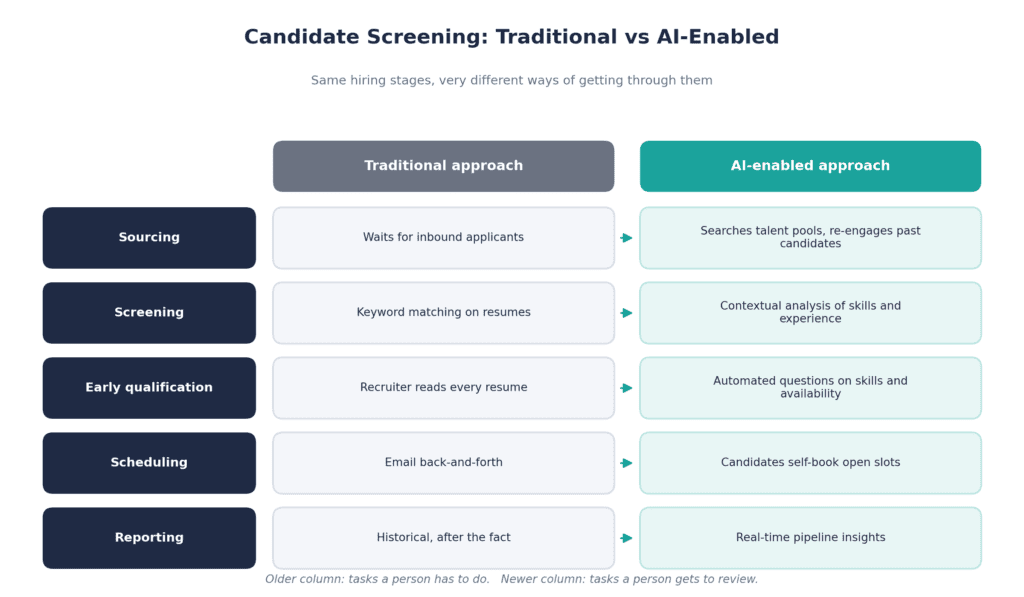
The pattern is consistent. The older column describes things a person has to do. The newer column describes things a person gets to review.
Traditional Screening Processes
It’s worth slowing down on how traditional screening actually plays out day to day, because the pain is easy to underestimate until you’ve lived it. A recruiter opens a stack of resumes, skims for the must-haves, makes a quick pile of yes, no, and maybe, and repeats. When volume spikes, the “maybe” pile grows, and strong people sit in it for days.
Some of the best screening is still manual in spirit: a recruiter noticing that a gap in someone’s resume lines up with a career pivot, or that an unusual title hides a big scope of responsibility. That kind of reading between the lines is hard to replicate. The problem is that it can only be applied to as many resumes as one human can read before lunch.
Automated Resume Screening with AI
Automated screening takes the first pass off the recruiter’s desk. Rather than filtering on exact phrases, the system reads each application against the requirements of the role and flags the ones that look strongest, often with a short explanation of why. Some tools go further and run a brief two-way conversation, asking a candidate about their experience, availability, or notice period, and attaching the answers to the profile.
The practical effect is that recruiters start their day with the interesting candidates already at the top. Vendor claims about time savings vary, and a few quote reductions in screening time as high as 70%, so treat those numbers as a starting point for your own pilot rather than a promise. Even conservative gains add up when the same task repeats hundreds of times a month.
Benefits of Predictive Hiring Analytics
Predictive hiring analytics is the part that makes people sit up in meetings, because it shifts reporting from “what happened” to “what’s likely next.” By looking at past hiring data, such as which sources produced hires who stayed, which stages tend to stall, and which profiles progressed fastest, these tools can point you toward the channels and candidate types most likely to work for the next opening.
In practice, that can mean spending your job board budget where it actually produces hires, spotting a bottleneck at the offer stage before it becomes a pattern, or knowing early that a pipeline for a particular role is running thin. Predictions are only as good as the data behind them, so teams with messy or sparse records will see weaker results at first. It’s an area where a little data hygiene pays off quickly.
Interview Scheduling Automation
If you want to see the gap between old and new at its most human, look at scheduling. The traditional version involves a recruiter proposing times, a candidate replying hours later, a hiring manager’s calendar changing, and the cycle restarting. It’s tedious, and it’s also where candidates quietly lose interest.
Interview scheduling automation removes most of that. The system reads available slots from the interviewers’ calendars, offers them to the candidate, confirms the booking, and sends reminders. It sounds minor, but those saved hours are often the first thing teams notice after adopting AI tools, and they directly shorten the stretch between application and first conversation.
Traditional Methods vs AI Solutions
So where does that leave the comparison? Not at “old versus new, new wins,” in my view. It’s closer to “each approach is strongest in a different part of the process.” Let’s look at that across a few dimensions.
Enhancing Efficiency with Automation
Automation’s biggest gift is the removal of repetitive, low-judgment work: parsing, sorting, scheduling, reminding, updating statuses. When those tasks stop consuming the day, recruiters can spend their hours on stakeholder alignment, interview preparation, and persuading great candidates to say yes. One vendor estimates recruiters can reclaim ten to fifteen hours a week. Your mileage will vary, but even a fraction of that changes how a recruiter’s week feels.
Efficiency also shows up as consistency. Software applies the same criteria to the first candidate and the five-hundredth, which is difficult for any human to promise on a heavy week.
Impact on Candidate Experience
Candidates rarely complain about being screened. They complain about silence. A week without an update after applying is often enough for a good applicant to move on. Faster acknowledgments, clear next steps, and flexible scheduling go a long way, and this is an area where AI-enabled workflows tend to outperform manual ones simply because they never forget to reply.
There’s a flip side. Over-automation can make a process feel cold, and candidates are usually perceptive about when they’re talking to a script. The best experiences I’ve seen described pair quick, automated updates with real people showing up at the moments that matter: the interview, the feedback call, the offer conversation.
Mobile matters here too. Nearly 70% of job seekers reportedly apply from their phones, and long, desktop-style forms push a lot of them away before they finish. A hiring process built for phones isn’t a luxury anymore.
Candidate Assessment Platforms
Candidate assessment platforms sit between screening and interviewing. They give applicants a chance to show what they can do, through skills tests, structured questions, work samples, or conversational evaluations, instead of asking recruiters to infer ability from a resume. Many now adapt follow-up questions based on how the candidate answers, which makes it harder to coast on rehearsed responses.
Used well, they widen the door. Someone self-taught, or someone whose resume undersells them, gets an equal chance to demonstrate skill. Used badly, they become one more hurdle that tests people’s patience more than their ability, so length and relevance deserve as much attention as scoring.
Standardized Assessments in Traditional Methods
Standardized testing isn’t new. Aptitude tests, personality questionnaires, and structured interview guides have been part of traditional recruitment methods for decades, and they remain valuable because they make comparison fairer than a casual chat ever could.
Their limits are practical. Paper or fixed-format tests are slow to administer and score, they’re the same for every role regardless of context, and their results tend to live in a separate file from the rest of the candidate’s record. Their strength is rigor. Their weakness is rigidity.
AI-Driven Assessment Tools: Pros and Cons
AI-driven assessments deserve a balanced look, because the enthusiasm around them can run ahead of the evidence.
- The upside:
- Faster evaluation at scale, with results ready before a recruiter has opened the application.
- Adaptive questioning that probes real depth of knowledge rather than memorized answers.
- Consistent, structured scorecards that hiring managers can compare side by side.
- Potential to reduce certain human biases by focusing on job-relevant skills rather than names, schools, or photos.
- The downside:
- Models can inherit bias from the historical data they learned from, so audits matter.
- Opaque scoring erodes trust. If you can’t explain why someone was rated low, you can’t defend the decision.
- Candidates may feel uneasy being evaluated by a system, particularly when no one explains how it works.
- Over-reliance can sideline recruiter intuition on exactly the cases where intuition is most useful.
Research on recruiter-and-AI collaboration points toward a sensible middle path: use algorithms to bring structure and consistency, and keep people in the loop to question the output and catch what a model can’t see. Treat the AI as a second opinion, not the final word.
Employee Engagement Metrics as a Success Measure
Here’s something teams often overlook: a good hire isn’t measured on the day the offer is signed. Employee engagement metrics, such as onboarding satisfaction, early-tenure retention, manager feedback in the first ninety days, and pulse survey results, tell you whether your hiring process is bringing in people who actually thrive.
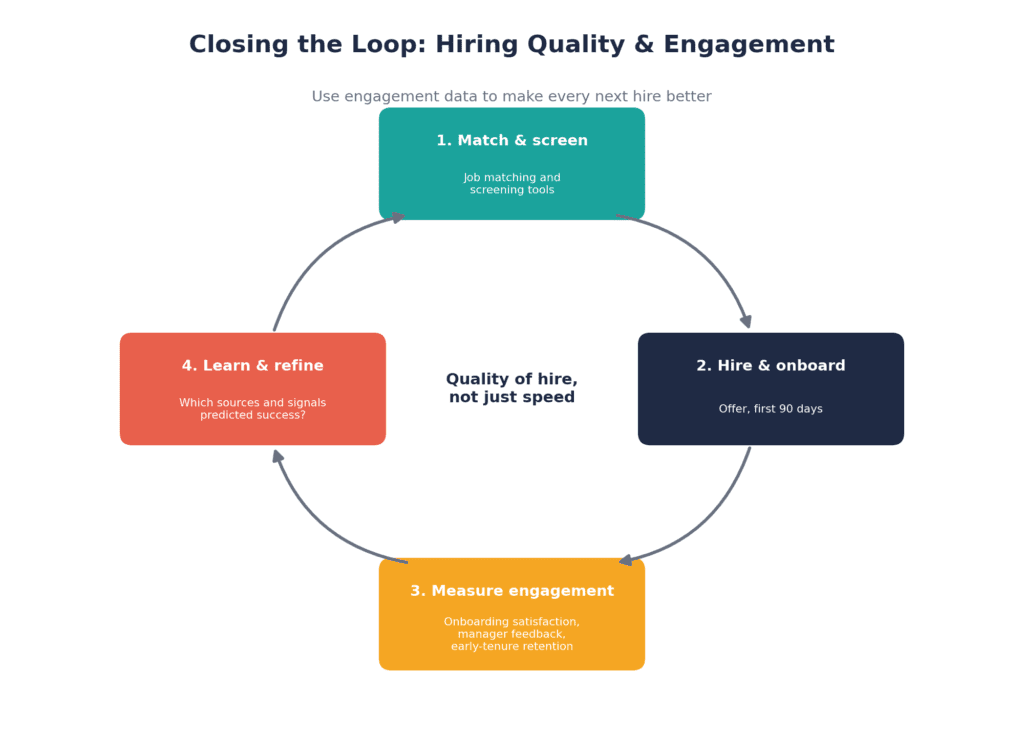
This is where AI tools can quietly earn their keep. When engagement and retention data feed back into your matching and screening, you can start asking sharper questions. Which sources produce people who are still here and engaged a year later? Which screening signals actually predicted success? Time-to-fill is a useful speed metric, but pairing it with engagement data keeps you honest about quality.
Recruitment Process Optimization
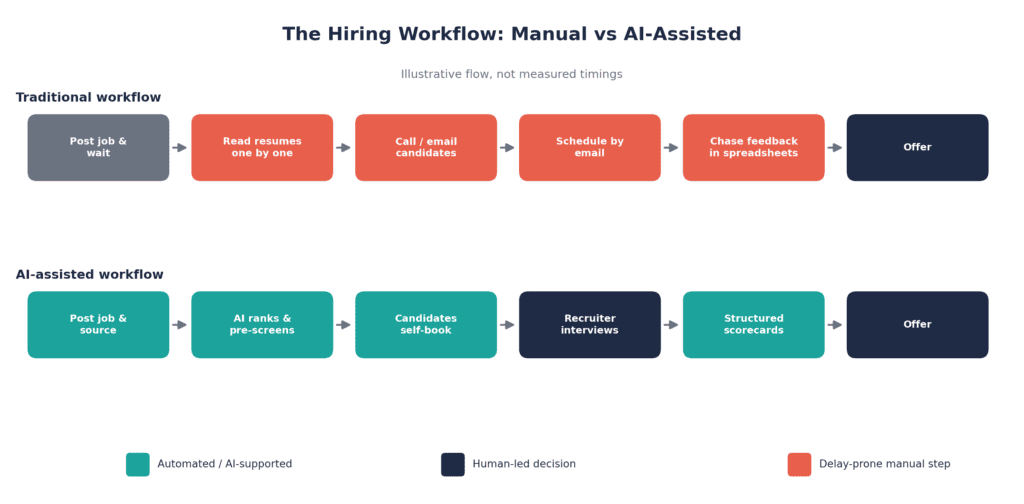
Recruitment process optimization is less about buying a tool and more about asking where your process leaks time, candidates, or trust. Start by mapping each stage from job approval to day one and noting where candidates wait the longest. The stage with the longest wait is usually your best first candidate for automation.
A few principles tend to hold up:
- Fix the biggest delay first rather than automating everything at once.
- Keep humans in charge of the decisions that carry the most consequence.
- Choose tools that plug into your existing ATS and calendars rather than forcing a migration.
- Measure before and after, so you know what really changed.
Traditional Recruitment Workflow
It helps to see the old workflow laid out plainly. Job requisition approved. Posting goes live on a few boards. Applications trickle in. A recruiter reads resumes, phones the promising ones, books interviews by email, gathers feedback in a spreadsheet or the ATS, and chases hiring managers for decisions. Offer, negotiation, paperwork.
Every step works. The trouble is that most of them depend on one person’s availability, so any delay at one stage ripples through the rest. When hiring volume is modest, that’s manageable. When it grows, it becomes the bottleneck everyone complains about.
Streamlining with AI: Case Studies
I’d rather not invent customer results, so instead of quoting named clients, here are three composite scenarios that reflect patterns commonly reported by hiring teams. They’re illustrative, not audited outcomes.
- A growing tech company. A lean talent team was drowning in applications for engineering roles, with many resumes differing only in phrasing. After adding context-aware screening and automated scheduling, recruiters stopped reading every application top to bottom and started their week with a ranked shortlist. The change they noticed first wasn’t speed alone but the quality of conversations, since they were speaking to better-matched people.
- A hospitality group hiring seasonally. Seasonal spikes used to mean weeks of phone tag. By moving pre-screening to text messages and letting candidates self-book interviews, the team cut the wait between application and first contact from days to hours, and no-shows dropped because reminders arrived where candidates actually looked.
- A staffing agency with long-tail talent pools. Past applicants used to sit untouched once a role closed. With matching tools that re-surface previous candidates for new openings, the agency started filling some roles from its own database before posting externally.
In each case, the human recruiters weren’t removed. They were redeployed toward interviews, relationship-building, and closing. If you’re planning a pilot, I’d suggest running something similar: choose one role type, measure time-to-hire and candidate feedback before and after, and let your own numbers tell the story.
Conclusion
So, how do AI hiring tools differ from traditional recruiting software? In short, traditional systems store and organize, while AI tools analyze, match, and act. The older approach gave us structure and a reliable paper trail. The newer one adds speed, context, and the ability to scale without burning out the people doing the work.
But the best answer isn’t a winner-takes-all verdict. Use automation for the repetitive, high-volume tasks, such as resume parsing, first-pass screening, scheduling, and reporting. Keep people in charge of interviews, fairness review, and final decisions. Teams that blend the two tend to get faster hiring without losing the human touch that candidates remember.

If you’re deciding where to start, pick the stage of your process that frustrates your team most, test one tool against it, and judge the result by both speed and the quality of the hires that follow.
Future Trends in AI Hiring Tools
A few directions seem likely to shape the next few years:
- More agentic workflows. Tools that don’t just suggest, but carry out multi-step tasks like sourcing, screening, and scheduling under recruiter supervision.
- Stronger verification. As generative AI makes polished fake resumes easy to produce, expect more emphasis on identity checks and genuine skill verification.
- Greater transparency. Explainable scoring and regular bias audits are moving from nice-to-have to expected, especially as regulation tightens.
- Mobile and conversational by default. Text and chat-based hiring that meets candidates where they already are.
- Tighter links to retention. Engagement and performance data flowing back into matching models, so hiring is judged by how people do after they join, not just how quickly they were found.
The tools will keep changing. The part that won’t is that people choose to join companies because of other people, and good recruiting will always be about making that connection easier.